

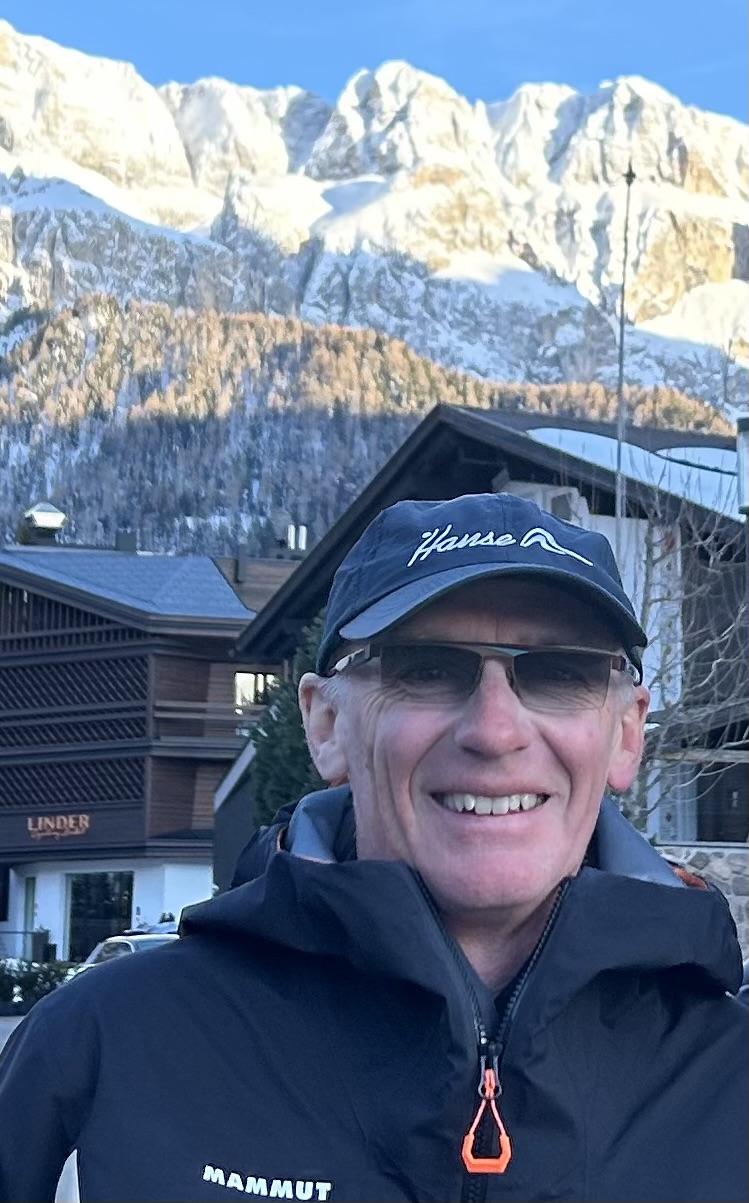
After more than 30 years in strategy consulting, including 25 as a partner at L.E.K., Simon Barrett had worked on over 800 projects across Australia, the UK, Europe and Asia. His career placed him at the apex of decision-making, advising CEOs, government departments and boards through mergers, infrastructure booms and multi-billion-dollar inflection points.
Last year, Simon stepped away from full-time work. What followed was a self-described “gap year” and a new question: how much of what I’ve learned in big corporates could apply to startups?
In December 2025, I sat down with Simon to reflect on a career that has shaped boardroom decisions, national infrastructure and generations of leaders. Our conversation explored what happens when that depth of experience meets early-stage startups, and why, for Simon, impact is far from finished.
The Gap Year 🦪
Bell: Simon, tell me what led you here? What led you into First Believers?
Simon: Well I’m semi-retired, as I describe myself. I gave up full-time work last Christmas, so this has been my first 12 months of semi-retirement.
As I got to the end of that, I realised I didn’t really feel like I was ready to be put out to pasture. So I talked to a lot of people about how they found joy and engagement and relevance post full-time work.
A surprising number said, “Have you thought about the startup community?”
I was in strategy consulting for 30 years. One of the wonderful things about that career is the variety. You’re constantly presented with different challenges and circumstances that corporates or government are facing. A number of people said to me, “After working in consulting, I think you could find board governance roles for large companies quite dry. I think you’d get much more enjoyment out of participating in the startup ecosystem.”
So it;s early days, but First Believers has been a really great way to dip my toe in the water.
800 projects and a once-in-a-generation build 🛤️
Bell: Tell me a bit more about the ‘pre-retirement’ Simon? What were you doing?
Simon: I was a partner with L.E.K. for 25 years and worked there for over 30. As I retired, they told me I’d worked on 800 projects, which is a lot. It’s a big library of experiences of people facing one of those fork-in-the-road moments in their trajectory.
That’s been everything from big mergers and acquisitions or divestments, to new policy initiatives for government, major capex proposals, building big infrastructure, or fine-tuning pricing or distribution. Any gamut of strategic or commercial issues of consequence.
I had the great pleasure of working with some of Australia’s best business leaders, many of who I now count as friends.
In my final 15 or 20 years, I landed in transport and infrastructure. We’ve just been through a once-in-a-generation investment boom in Australia, particularly Sydney, Melbourne and Brisbane. Projects like metros in Sydney, the big build in Melbourne, Western Sydney Airport, Inland Rail. That level of investment doesn’t happen all the time.
I had the privilege of a ringside seat helping people organise their thinking and execution through what is well over $100 billion of infrastructure that has changed the face of cities quite dramatically.
Newtonian physics vs quantum physics 🍎
Bell: So startups are quite new for you Simon. What question did you bring with you into the startup / tech world?
Simon: I was trying to figure out how much of my 30-plus years of knowledge from big corporates and government was actually relevant to startups.
I’d seen friends and family start small businesses, and what led them to succeed or fail wasn’t always something I would have thought much about when advising an ASX CEO.
At the end of the First Believers program, I said it felt a bit like when someone explains the difference between Newtonian physics and quantum physics. Some of the rules are still the same, but some are really, really different and you have to get your head around them.
At the end of the day, they’re all businesses. They still have customers, products, staff and a profit and loss to worry about. So many of the things I’ve spent my time working on feel familiar.
What’s different is things like the critical importance of speed. Speed is important in large corporates, but you’re talking about different orders of magnitude.
Secondly, the critical importance of the founders. Why? Because the business model may change three, four, five times before they get on the right trajectory.
And the fact that in startups the offer has to be 10 times better than the alternative. Not many corporates think in those terms. They’re thinking about incremental or significant improvements, not 10 times better.
But things like clear differentiation and crystal-clear communication, being able to distill something inherently complex and make it simple, that’s very familiar territory.
Why Australia is finally spinning the flywheel 🌀
Bell: How do you see Australia’s startup ecosystem evolving?
Simon: I think there’s a bit of a flywheel effect when you’ve got success beginning to spin off. Founders go into their second and third startups. They’ve got capital to invest.
Australia is not lacking in capital. We have one of the world’s most successful superannuation systems.
What we’ve really lacked is the connection mechanisms between that pool of capital and the innovation opportunities that exist. Suddenly, that flywheel seems to be generating positive and mutually reinforcing benefits.
It’s nice to arrive at this point in time.
Ethics, impact and not taking yourself too seriously 🙌
Bell: In First Believers we discuss a lot about your investment thesis and building your own framework for investing. What would you say are the values for you that guide both your work and decision making?
Simon: I’m a big believer in do no harm. I was raised in a pretty ethical household. My parents guided me pretty early on not to cross lines and to think carefully about conflicts of interest, or how things would look if they showed up on the front page of the newspaper or had to be explained to a magistrate in court.
So I’ve always had a strong ethical streak.
The second thing would be making a difference. None of us have endless years on this earth, so you might as well do something interesting and impactful with your time.
In the First Believers community, I found a lot of people who share that ethos. They’re not there just to ‘clock watch’. They want to shift the world positively, whether that’s for communities, employees, customers, the environment, public health or mental health.
And not taking yourself too seriously. Some of the business leaders I admire most were quite humble. Despite being some of the smartest and most dynamic people I’d met, they were open to advice and often a little self-deprecating.
What brings you joy?
Bell: Now being semi-retired, tell me about the weekly routines or rituals in your life right now that bring you joy?
Simon: I’ve started sailing on Wednesday afternoons. I stared out of my office window in a Sydney skyscraper for many years looking at people sailing on Wednesday afternoons. Now I get to do that too.
I’ve also gone back to running since COVID. I only do 5k, I’m not a marathon runner, but I go two or three times a week. I do Parkrun when I can, even when I’m travelling.
When you exercise, you arrive at your job more energised, not less. It keeps the neurons firing. I’m still finding that in retirement.
If you’ve spent years building expertise inside established organisations, First Believers is where that experience meets early-stage ambition. Your knowledge isn’t left at the door, it becomes your edge.
Join us in the next cohort!